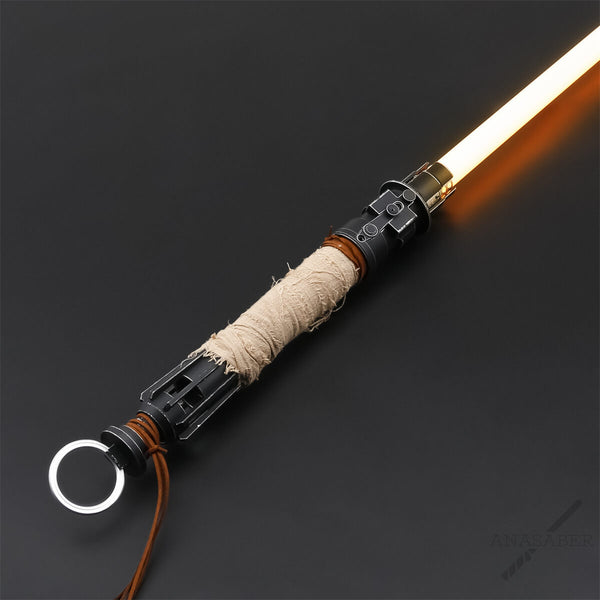

In Star Wars: The Last Jedi, on the remote, ocean-wreathed island of Ahch-To, Luke Skywalker—the Jedi Master who once illuminated the galaxy—had become a reclusive hermit, just like Master Yoda before him. When Rey crossed the starry sea to find him, begging him to return with the hope of the Resistance in her hands, Luke turned her away with cold indifference. He not only renounced rebuilding the Jedi Order, but had also voluntarily severed his connection to the Force.
The Force is the lifeblood of the Jedi, the very wellspring of power that carried Luke from a young hero to a legendary Master. So why would he cut this sacred bond with his own hands?
Hidden behind this choice is a tragedy great enough to crush all hope for the Jedi, and a lifelong journey of redemption that defined the rest of his days.
When trust between Master and Apprentice crumbled, did a Jedi initiate turn into a ruthless executioner?
The origin of all tragedy lay in a fatal misjudgment by Luke Skywalker toward his apprentice, Ben Solo.
Back then, Luke saw hope for the Jedi Order’s revival. He took Ben Solo as his apprentice and imparted to him all his mastery of the Force and life wisdom. Ben was the son of Han Solo and Princess Leia, blessed with the Force-sensitive gift of the Skywalker bloodline, yet harboring an untamable dark side—a darkness that stemmed both from his grandfather Darth Vader and the insidious manipulation of Snoke, the dark lord of the First Order.
One late night, Luke sensed that the darkness within Ben had spiraled out of control. He slipped quietly into his apprentice’s quarters, attempting to probe the truth through the Force. Yet when the density of that darkness exceeded all his expectations, Luke was seized by a sudden surge of fear and anxiety, and instinctively drew his lightsaber.
The blade was unsheathed for only a fleeting moment, but it became the final straw that broke Ben. In his apprentice’s eyes, that lightsaber stood for his master’s distrust, the prejudice of the Jedi Order, and a total rejection of the inner turmoil he had been fighting.
In that single second of misjudgment, Ben Solo turned irrevocably to the dark side, reborn as Kylo Ren—the ruthless executioner of the First Order. He personally destroyed Luke’s Jedi Academy and slaughtered his fellow Jedi apprentices.
Luke's Guilt and the Ultimate Questioning of the Jedi Order
Kylo Ren's fall became a shackle Luke could never break free from for the rest of his life. At first came overwhelming guilt: the apprentice he had personally trained, who should have been the future of the Jedi Order, had turned into a nightmare for the galaxy; the young apprentices who fell to Kylo's blade all perished because of his fatal misjudgment. This guilt, like a shadow of the Force, gnawed at his heart day and night.
What followed was a complete loss of faith in his own abilities. Luke had once firmly believed he could escape his father's shadow and mend the scars left by the Galactic Empire, but reality dealt him the cruelest blow—he could not even save the apprentice he valued most, and had instead pushed him into the dark side with his own hands. What drove him to despair even more was that he began to question the very meaning of the Jedi Order: from the ancient Jedi to his own masters Obi-Wan and Yoda, the Jedi had always been trapped in a cycle of "light versus dark," yet never truly vanquished the dark side. Instead, time and again, their rigidity and arrogance had spawned tragedy. He realized that perhaps the very existence of the Jedi was the soil in which darkness took root.
When guilt and doubt had piled up into utter despair, Luke chose the most extreme path: self-exile. He took the last remaining Jedi ancient texts and fled to Ahch-To, a corner forgotten by the Force, seeking to shut out the world with solitude. And severing his connection to the Force was the ultimate ritual of this self-imposed exile.
Why did Luke voluntarily sever his connection to the Force?
Luke’s act of severing his connection to the Force was never a “loss of the Force”—it was a voluntary sealing off of his perception, and behind it lay three heavy, profound intentions.
First was escape. The Force is the bond that connects all things in the galaxy. Through it, he could clearly sense the carnage wrought by Kylo Ren, the suffering of the Resistance, and the agony of the galaxy’s people. Each of these pains cut like a blade; every perception flayed the wounds in his heart. By cutting the connection, he no longer had to face this agony head-on, nor torment himself over a reality he was powerless to change.
Second was atonement. In Luke’s eyes, the fall of Kylo Ren and the destruction of the Jedi Academy were entirely his fault. The Force was the mark of his status as a Jedi Master—and also the very source of his failure. Had he not possessed such powerful Force-sensitivity, he would not have been so easily driven by fear; had he not taken on apprentices as a Jedi Master, Ben Solo would never have been burdened with such crushing expectations. Stripping himself of his most precious bond to the Force became his act of penance—to the apprentices who perished, to Ben Solo consumed by the dark side, and to the entire galaxy.
Last was self-punishment. As the heir of the Skywalker lineage and the hero who defeated the Empire, Luke had lived his entire life by the tenets of light and duty. But this single misjudgment left him feeling unworthy of the Force, unworthy to be called a Jedi Master. Severing the connection was his cruelest form of self-punishment: a Jedi without the Force was no different from an ordinary being. It was both penance for his mistakes and a temporary farewell to his identity as a Jedi.
Luke's Jedi Rebirth
Many see Luke’s self-exile as cowardice, and his severing of the connection as an abandonment of the galaxy—but the truth is the exact opposite. What he cut was his external bond to the Force, yet he never let go of the light and duty within his heart.
When Rey found him bearing hope, and when the Resistance stood on the brink of annihilation, Luke finally understood: flight could solve nothing, and the ultimate form of atonement was not self-punishment, but confronting his mistakes head-on. And so, he reawakened the Force within him, appearing on Crait through a trans-galactic Force projection. At the cost of his own life, he held Kylo Ren and the First Order at bay, buying the Resistance precious time to evacuate.
That awe-inspiring projection was both his reconnection to the Force and the culmination of his redemption. From severing the bond to sacrificing himself through a Force projection, Luke proved through a lifetime of struggle: a true Jedi is not defined by the strength of their power in the Force, but by the willingness to stand up for the light—even after enduring the deepest pain and despair.
He cut the connection to run from his failures, yet his final sacrifice was made to atone for them. This is the real Luke Skywalker: a legend of flesh and blood, one who struggled, grew, and rose again.
FAQ
1. Did Luke lose his ability to use the Force after severing his connection?
2. Was Luke entirely responsible for Ben Solo’s fall to the dark side?
3. Why did Luke choose to sacrifice himself via Force projection on Crait instead of joining the Resistance directly?
4. What did Luke mean by accusing the Jedi Order of "rigidity and arrogance"?
5. How does Luke’s self-exile on Ahch-To compare to Yoda’s exile on Dagobah?
- Yoda’s exile (after Order 66) was forced—he fled to survive the Empire’s Jedi purge and wait for a chance to train the next hope (Luke). He remained connected to the Force and focused on the future.
- Luke’s exile was self-imposed—driven by guilt, despair, and a crisis of faith in the Jedi Order. He actively severed his Force connection to escape pain, not to plan a comeback. His retreat was a form of punishment, whereas Yoda’s was a strategic sacrifice.
6. Could Luke have prevented the destruction of his Jedi Academy if he had reacted differently to Ben’s darkness?
7. Why did Luke take the last Jedi ancient texts to Ahch-To if he wanted to abandon the Jedi Order?